
Mar 14, 2017
My concern for the Rotherham landlords and homeowners is the older members of the population in our town.
I recently wrote an article about the plight of those in their 20s who are often referred to by the press as ‘Generation Rent’. Attitudes to renting have certainly changed over the last twenty years and as my analysis suggested, this change is likely to be permanent.
In the article, whilst a minority of this Generation Rent feel trapped, the majority don’t – making renting a choice not a predicament.
The Royal Institution of Chartered Surveyors (RICS) predicted that the private rental sector is likely to grow substantially by 1.8m households across the UK in the next 8 years, with demand for rental property unlikely to slow and newly formed households continuing to choose the rental market as opposed to buying.
However, my real concern for Rotherham homeowners and landlords, as I discussed a couple of months ago, is our mature members of our population. In that previous article, I stated that the current OAPs (65+ yrs in age) in Rotherham were sitting on £1.59bn of residential property.
However, I didn’t talk in depth about the ‘Baby Boomers’ in the 50-64 age bracket.
Baby Boomers: what are their properties are worth – and more importantly, how is this current state of affairs holding back the younger ‘Generation Rent’?
In Rotherham, there are 6,664 households whose owners are aged between 50 and 64yrs and about to pay their mortgage off. That property is worth, in today’s prices, £947.2m.
There are an additional 8,110 mortgage free Rotherham households, owned by Baby Boomers which is worth £1.15bn in today’s prices.
This means that, in total…
Rotherham Baby Boomers and Rotherham OAPs are sitting
on £3.64bn worth of Rotherham Property

These Rotherham Baby Boomers and OAPs have 25,626 Rotherham properties. Many of them feel trapped in their homes, and hence I have dubbed them ‘Generation Trapped’ in the title to this article.
Recently, the English Housing Survey stated 49% of the properties owned by the Generation Trapped are ‘under-occupied’ (under-occupied classed as having at least two bedrooms more than needed).
These houses could be better utilised by younger families, but research carried out by the Prudential suggest in Britain it’s estimated that only one in ten older people downsize. Compare this with the USA where one in five downsize.
The growing numbers of older homeowners who want to downsize their home are often put off by the difficulties of moving.
The United for all Ages charity suggested recently that people are put off by
- the lack of housing option
- the hassle and cost of moving
- having to declutter their possessions
- family reasons such as staying close to children and grandchildren.
Helping mature Rotherham homeowners to downsize at the right time will also enable younger Rotherham people to find the homes that they need.
This would mean that every generation wins, both young and old.
However, to ensure downsizing works across the country we need to provide more choices for these ‘last time buyers’.
Theresa May and Philip Hammond can do their part and consider stamp duty tax breaks for downsizers. Additionally, our local Council and the Planning Dept. should play their part, as should landlords and property investors to ensure Rotherham’s ‘Generation Trapped’ can find suitable property locally, close to friends, family and facilities.
If you need advice about downsizing I would be happy to help. Please get in touch with me.
Please follow me on Twitter or Facebook to hear about the latest goings on in the Rotherham property market. Let me know what you think of the blog and my thoughts about ‘Generation Trapped’
Mar 13, 2017
Are houses becoming less affordable in Rotherham?
A Rotherham homeowner emailed me last week following my article about the change in attitude to renting by the youngsters in our town. They thought it was too expensive for first time buyers to buy in our town.
There can be no doubt that buy-to-let landlords have played their part in driving up property values in Rotherham (and the UK) and from that made housing a lot less affordable for those in their 20s and 30s.
Should the BoE be charged with containing buy-to-let housing market?
In the email they asked if the Bank of England (BoE) should be tasked to control house price inflation in the same way as the BoE controls inflation. The BoE has a target for the annual inflation rate of the Consumer Prices Index of 2%, whilst it is also required to support the Government’s economic policy, including its objectives for growth and employment. The BoE could get involved by possibly changing the rules on the loan-to-value (LTV) ratios.
Let’s look at how affordable Rotherham is.
The best measure of the affordability of housing is the ratio of Rotherham Property Prices to Rotherham Average Wages – the higher the ratio, the less affordable properties are. (eg. looking at the table below, for example in 2014, the average value of a Rotherham property was 5.02 times higher than the average annual wage in Rotherham)


The deterioration in affordability of property in Rotherham over the last couple of years has been one of the reasons why the younger generation is deciding more and more to rent instead of buy their own house.
… but it’s not the only reason.
A quick look on Money Supermarket today found 169 lenders prepared to offer 75% LTV buy-to-let mortgages and none at 85% LTV. Lenders have self-imposed a high level of entry for buy-to-let landlords (i.e. putting down at least 25% of the purchase price in cash). The BoE don’t need to meddle there!
In addition, the Tories have certainly done lots to level the playing field in favour of first time buyers. For nearly a year now, landlords have had to pay an additional 3% in stamp duty on any buy-to-let purchase. Over the coming four years, tax rules on landlord’s claiming mortgage interest relief will affect their pocket. It also doesn’t help that the local authority sold off council houses in the Thatcher years meaning that for so many on low incomes or with little capital, owning a home has simply never been an option (today or in the past).
It’s easy to look at the headlines and blame landlords.

First time buyers have been able to access 95% LTV mortgages since 2010, meaning even today, a first-time buyer could purchase a 3 bed terraced in Rotherham for around £100,000 and would only need to find £5,000 deposit.
Yes, a lot of money, but first time buyers need to decide what is important to them. Reducing in other areas of life (such as foreign holidays or the latest iPhone with expensive contract) can free people up to save for a deposit.
I think we as a country have changed… renting is returning to be the norm.

So my opinion is this: landlords have it tough.
Let’s not blame them for the perceived woes of the nation.
At the end of the day, if we are really honest we haven’t always been a country of homeowners. Roll the clock back to 1964, and nationally, 30% of people rented their home from a private landlord. Today the national figure is only 15.3%.
If you are an existing landlord or someone thinking of investing in buy-to-let property I am happy to give you advice. Get in touch with me here. In the meantime, please follow me on Facebook and Twitter for the latest insights into the property market here in Rotherham.
Mar 10, 2017
The Rotherham housing market has gone through a sea change in the past decades. In particular, the Buy-to-Let (B-T-L) sector has been evolving for both Rotherham tenants and landlords.
A few weeks ago, the Government released a White Paper on housing. I have had a chance now to digest the report and wish to offer my thoughts on the topic. It was interesting that the private rental sector played a major part in the future plans for housing. This is especially important for our growing Rotherham population.
In 1981, the population of the Rotherham Council area stood at 253,200 and today it stands at 260,800.
Currently, the private rented (B-T-L) sector accounts for 11.8% of households in the town. The Government want to assist people living in the houses and help the economy by encouraging the provision of quality homes, in a housing sector that has grown due to worldwide economic forces, pushing home ownership out of the reach of more and more people.
Interestingly, when we look at the 1981 figures for homeownership, a different story is told:
- 45.94% Rotherham people owned their own home
- 45.78% Rotherham people rented from the Council or Housing Association
- 8.28% Rotherham rented from a private landlord

The significance of a suitable housing policy is vital to ensure suitable economic activity and create a vibrant place people want to live in.
 With the population of the Rotherham area set to grow to 277,000 by 2037, it is imperative that the council and the UK Government all work actively together to ensure the residential property market doesn’t hold the area back, by encouraging the building and provision of quality homes for its inhabitants.
One idea the Government has proclaimed is a variety of measures aimed at encouraging the Build-to-Rent (B-T-R) sector (instead of the B-T-L sector). These include allowing local authorities to proactively plan for B-T-R schemes, and making it simpler for B-T-R developers to offer inexpensive private rented homes.
To do this, the government will invent a distinct affordable housing class for B-T-R, called ‘Affordable Private Rent’, which will oblige new homes builders to provide at least 1 in 5 of a new home developments at a 20% discount on open-market rents and three year tenancies for tenants. In return, the new homebuilders will get better planning assurances.
Private landlords will not be expected to offer discounts, nor offer 3-year tenancies – but it is something Rotherham landlords need to be aware of as there will be greater competition for tenants.
Over the last ten years, home ownership has not been a primary goal for young adults as the world has changed.
These youngsters expect ‘on demand’ services thanks to Amazon, Dating Apps and Netflix.
Many Rotherham youngsters see that renting more than meets their accommodation needs as it combines the freedom from a lifetime of property maintenance and financial obligations. For them, this is an attractive lifestyle option.
Private rented housing in Rotherham, whether that’s through B-T-L or B-T-R, has the prospective to play a very positive role.
You can hear about my latest thoughts on the property market here in Rotherham and across the UK by following me on Facebook or Twitter.
Mar 8, 2017
Everyone should own their own home – that was the message of the Margaret Thatcher government.
In 1971, around 50% of people owned their own home. However, as the baby boomers got better jobs and pay, that proportion of homeowners rose to 69% in 2001. Homeownership was here to stay.
Thanks to TV programmes such as Homes Under The Hammer, baby boomers started to jump on the buy-to-let bandwagon – people in Rotherham invested in these properties as an investment. Now Rotherham first time buyers were in competition with the landlords to buy these smaller starter homes. This pushed up house prices in the 2000s (as mentioned in Part One). When combined with economics, banks and government policy, the prices are now beyond the reach of many first time buyers.
But are the Rotherham landlords fanning the flames of the housing crisis bonfire?
My opinion is that the landlords of the 5,416 Rotherham rental properties are not exploitive. In fact, they are making many positive contributions to Rotherham and the people who live here. Like I have said before, Rotherham (and the rest of the UK) isn’t building enough properties to keep up the demand caused by high birth rates, job mobility, growing population and longer life expectancy.
According to the Barker Review, for the UK to standstill and meet current demand, the country needs to be building 8.7 new households each and every year for every 1,000 households already built. Nationally, we are currently running at 5.07 per thousand and in the early part of this decade were running at 4.1 to 4.3 per thousand.
It doesn’t sound a lot of difference, but let us look at what this means for Rotherham …
For Rotherham to meet its obligation on the building of new homes, Rotherham would need to build 399 households each year.
Unfortunately we are missing that figure by around 167 households a year.
For the Government to buy the land and build those additional 167 households, it would need to spend £24,473,638 a year in Rotherham alone. Add up all the additional households required over the whole of the UK and the Government would need to spend  £23.31bn each year… I don’t know if you’ve noticed but the country hasn’t got that sort of money
With these problems, it is the property developers who are buying the old run-down houses and office blocks which are deemed uninhabitable by the local authority, and turning them into new attractive homes. These are either rented privately to Rotherham families or to those people who need council housing because the local authority hasn’t got enough properties to go around.
The bottom line is that, as the population grows, there aren’t enough properties being built for everyone to have a roof over their head.
Rogue landlords do need to be put out of business, whilst tenants should expect a more regulated rental market, with greater security for them. The system should ensure that tenants can rely on good landlords providing them high standards in a safe and modernised home.
As in Europe, where most people rent rather than buy, it doesn’t matter who owns the house – all people want is a clean, decent roof over their head at a reasonable rent.
So only you, the reader, can decide if buy-to-let is immoral, but first let me ask this question:
If the private buy to let landlords had not taken up the slack and provided a roof over these people’s heads over the last decade… where would these tenants be living now?
The alternative doesn’t even bear thinking about!
Have you enjoyed my two part blog series on the buy-to-let market? Let me know on Twitter or Facebook.
Mar 4, 2017
Recent statistics published by the Office of National Statistics show that there are 267,704 private rented households in the UK that are occupied by people aged 65+ – that’s 4.39% of OAPs living in private rented property.
This got me thinking two things:
1. How many of these OAPs have always rented?
2. How many have sold up and become a tenant?
In retirement, selling up could of course make financial sense to the mature generation in Rotherham. It potentially allows them to liquidate the equity of their main home to enhance their retirement income.
I wanted to know why these older people rent and whether there was opportunity for the buy-to-let landlords of Rotherham?
The Prudential published a survey recently that said nearly six out of ten OAP renters had never owned a home. 20% OAP renters were required to sell up because of debt and only one in ten OAP renters sold their property to use the money to fund their retirement. (The remaining 10% of OAP renters were renting for other reasons.)
Life expectancy is making it important to fund retirement.
For someone living in Rotherham who is aged 65, the current life expectancy is 18 years for a man and 20.1 years for a woman (interesting when compared to the national average of 18.7 years and 21.1 years). Funding retirement is therefore increasingly important.
The burdens of financing a long retirement are being felt by many mature people of Rotherham. The state of play is not helped by rising living costs and ultra-low interest rates reducing returns for savers.
So, what of Rotherham?
Of the 12,660 households in Rotherham, whose head of the household is 65 or over, not surprisingly 7,892 of households were owned (62.34%) and 3,795 (29.98%) were in social housing. However, the figure that fascinated me was the 526 (4.15%) households that were in privately rented properties.

Talking to members of my team at Bricknells Rentals and Fenton Board, as well as other Rotherham property professionals, it seems that this figure is rising. This is only anecdotal evidence but I’m convinced that more and more OAPs are selling their large Rotherham homes and renting something more manageable.
Why is renting a good option for OAPs?
Selling a large home and moving into the rental market allows OAPs to release all of their equity from their old home. This equity can be gifted to grandchildren (allowing them to get on the property ladder), invest in plans that produce a decent income and all the while living the retired life that they want to live.
These Rotherham OAP renters know they have a fixed monthly expenditure and can budget accordingly with the peace of mind that their property maintenance and the upkeep of the buildings are included in the rent. Many landlords will also include gardening in the rent!
Renting is also more adaptable to the trials of being an OAP – the capability to move at short notice can be convenient for those moving into nursing homes, and it doesn’t leave family members panicking to sell the property to fund care-home fees.
Rotherham landlords should seriously consider low maintenance semi-detached bungalows on decent bus routes and close to doctor’s surgeries as a potential investment strategy to broaden their portfolio. Get it right and you will have a wonderful tenant, who if the property offers everything a mature tenant wants and needs, will pay top dollar in rent!
Landlords, do you need more tips? Get in touch with me – I’d be happy to help.
Page 15 of 29« First«...10...1314151617...20...»Last » 


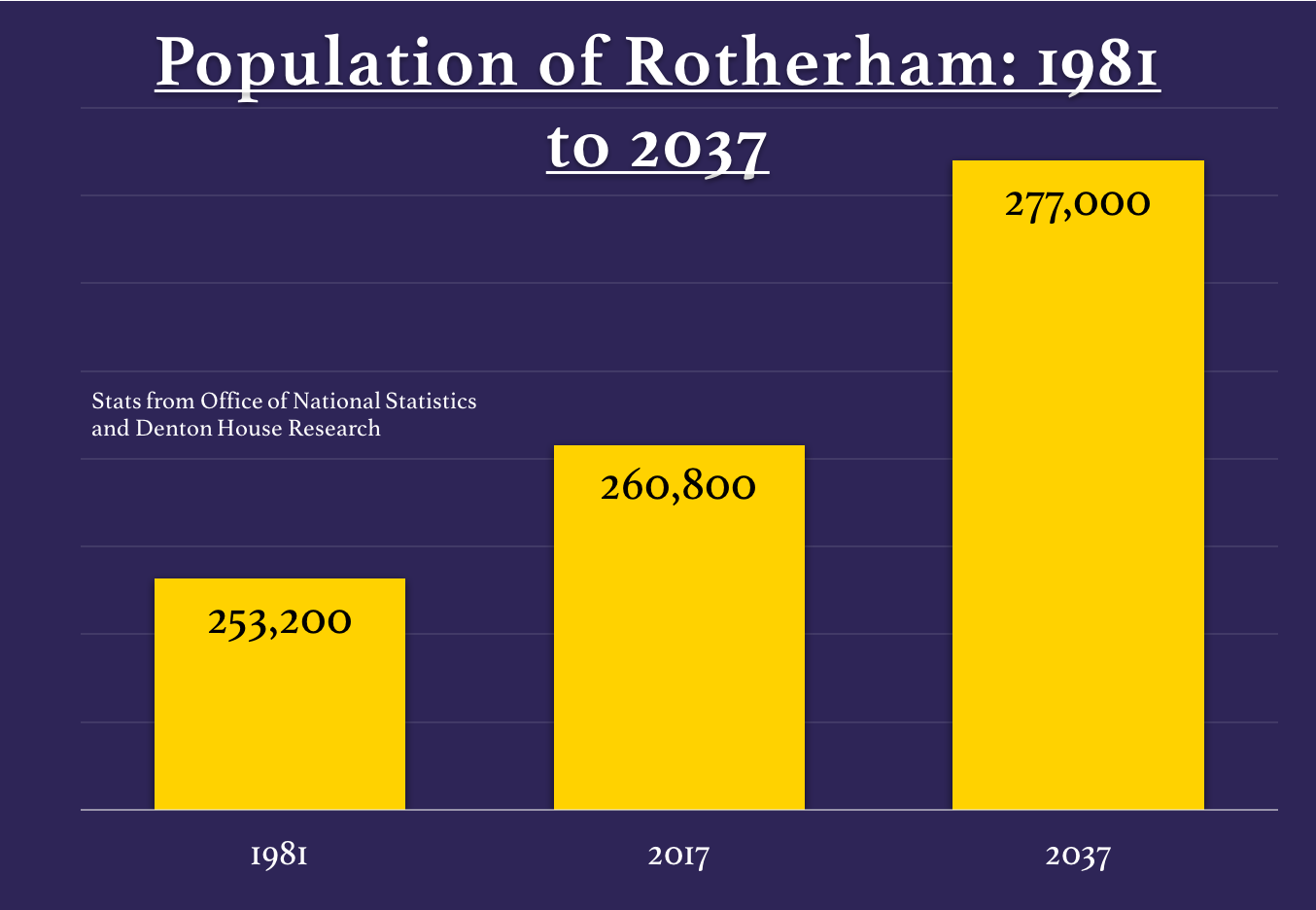 With the population of the Rotherham area set to grow to 277,000 by 2037, it is imperative that the council and the UK Government all work actively together to ensure the residential property market doesn’t hold the area back, by encouraging the building and provision of quality homes for its inhabitants.
 £23.31bn each year… I don’t know if you’ve noticed but the country hasn’t got that sort of money

